In memory of Jan Bollmann
Gold Panning in Lower Saxony "It works!"
Jan Bollmann had attended a gold panning course in Disentis, Switzerland, where the Rhine originates.
Unfortunately, the hoped-for nuggets did not materialize during the course.
He thought, "Now more than ever!" and bought gold panning equipment at a shop. A gold pan, sluice box, pump, shovel, and a bucket were included. With the help of his wife (Nicole Bollmann) and daughter (Victoria Bollmann), he tried it in various places, and lo and behold, after many hours of practice, the
first small nuggets lay in the gold pan. Immediately, gold fever was ignited, and the activity became more and more fun. The search was further driven by the successes of professional gold prospectors who, in days of work, cleared away huge boulders and dug ever deeper towards the so-called "bedrock" riverbed where the largest
nuggets are found.
Almost every day of the vacation was dedicated to the new hobby, and the number of gold nuggets steadily increased. But every vacation, as always, ends too quickly.
If only I could continue at home with the new equipment,
he thought! But in which river in Lower Saxony is there supposed to be gold?
Is there any gold in our rivers at all?
Back home in Wietze near Celle, he searched the internet for gold panning in Lower Saxony, but unfortunately, there were no hits. Has no one ever searched for and found gold in our rivers? Disappointed, he put the gold panning equipment in his treasure hunter's room with the metal detectors, his actual hobby.
Until a few days later, Bernd S., a friend, visited him. Proudly, the nugget finds and the gold panning equipment were presented. Bernd was so enthusiastic that he asked if he couldn't try gold panning in the Wietze, which is the river in the town of the same name. Jan Bollmann was enormously pleased with the question, as he could at least pretend to be in Switzerland and search for real gold. No sooner said than done, the two went with the gold panning equipment to a shallow spot in the Wietze on Jan Bollmann's adjacent property.
River sand was transported into the wash pan with the pump, and Jan Bollmann demonstrated professional gold panning. "That's how it works," he said, looking at the remaining black sand in the pan after washing it out.
But what was that? There was a tiny gold flake in the pan!!!
He couldn't believe it; the flake must have gotten stuck in the pump from the last wash in Switzerland...
The pump was flushed numerous times, and a new attempt was started.
Now things were getting eerie! There were two small lumps of gold in the pan!
Could there be gold in our rivers that no one knew about until now?
At home, the gold was compared under a microscope with that from Switzerland.
It really was small gold flakes and a crumb-sized nugget!
Jan Bollmann was overjoyed, and Bernd S. immediately wanted a gold pan too. In the following weeks, every free minute was dedicated to gold panning at home. The two also found gold in other nearby rivers and even in the Harz mountains.
Jan Bollmann wondered if he shouldn't teach gold panning to other interested people; his dream would be his own gold panning camp on the Wietze. He already owned a meadow on the Wietze with a large inner curve where he had found the first gold.
He decided to tell the mayor about the idea. The mayor and the German Oil Museum in Wietze were immediately enthusiastic about the idea. "From black gold to real gold" or something similar could be a headline for Wietze. The gold panning camp would also be directly adjacent to the Oil Museum! They even offered their support for its construction.
Now we can get started!
Jan Bollmann has already opened the first gold panning course with an adventure children's birthday party. A complete success; the children were thrilled when they saw real small gold particles in the gold pan. The course was sealed with a certificate for the participants.
Jan Bollmann wants to offer gold panning courses for everyone, also as an event with catering for groups at the gold panning camp with campfire, grilling, etc. He hopes that things will develop quite well in the near future. Inquiries are already coming in.
Of course, he also wants to open up more washing sites in other rivers and needs people with inquiries in the Lower Saxony area where the gold panning technique with the gold pan could be practiced in local rivers!
Here Lower Saxony's first gold panning camp is being built!

the gold has settled in this inner curve!

The first finds... The pictures are enlarged!


Nugget (Turtle)


Gold Panning Equipment
A gold pan, a shovel,
a hand pump, and buckets are needed.
The sluice box automatically processes the sediment as it is rinsed through and retains the heavy metal (gold).
The advantage of the sluice is a high throughput of material in a short time.
The so-called concentrate is finally washed out with the gold pan.
However, the sluice requires a lot of flow and cannot be used everywhere.
The Gold Sluice

The Gold Pan

The Installed Sluice

The sluice is filled with sediment

The concentrate from the sluice is rinsed into a bucket and collected

The concentrate is further washed out with the gold pan until only the gold remains

15 Gold Nuggets in the Pan!

The washed gold safely in the plastic tube

The Creation of the First Gold Panning Camp in Wietze
The finished gold panning troughs are being loaded...

Arrival at the Gold Panning Camp Wietze...

Jan Bollmann and Bernd Schmidt on the erected wash troughs...

The water channel for the wash troughs is being prepared...

Vicky's first test...

The water splashes, just as it should!

The filled wash troughs are waiting for gold panners...

View of the washing plant with the installed gold sluice...

Bernd washing the first pan...

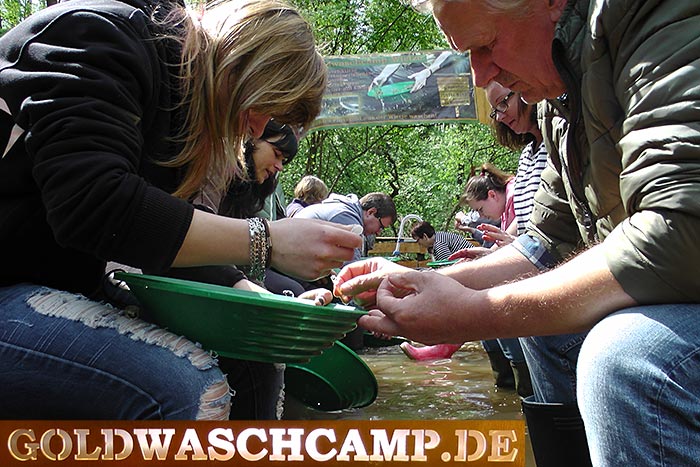
The first interested parties are fascinated by how the gold panning technique works...

The two most beautiful gold pieces from the Wietze directly from the river sand under the camp...

The Thuringian sausages are sizzling on the swivel grill...

The gold panner's table is inaugurated...

Jan Bollmann has implemented his gold panning camp idea and is satisfied with the result...

Gold Panning in Switzerland 2017


Gold panning at the Historical Museum Hannover 18.06.2017
On 18.06.2017, we set up a mobile gold panning camp at the Historical Museum Hannover for the Gold and Silversmiths' Guild Hannover. Here, everyone could attend a crash course in gold panning. The goldsmiths proved to have a steady hand, and only a few gold pieces from the bingo bag fell into the trough. A complete success!


We are now building another gold panning camp on Teufelsinsel in 2018
We have decided to build another gold panning camp on part of the Teufelsinsel property. This will be an all-weather camp with a water ditch, large pavilion, gold mine, fire pit, smoker, grill, and demonstration facilities for our gold washing systems. At "Camp Teufelsinsel," we will also be able to cater to larger groups with events and catering.
In the adjacent gold panning shop, every enthusiastic gold panner will immediately find the right equipment needed for the hobby.
The completion of the new camp is planned for 2018.
We will continue to report on the construction of the camp with pictures here!
Work was done here!
- Space was created
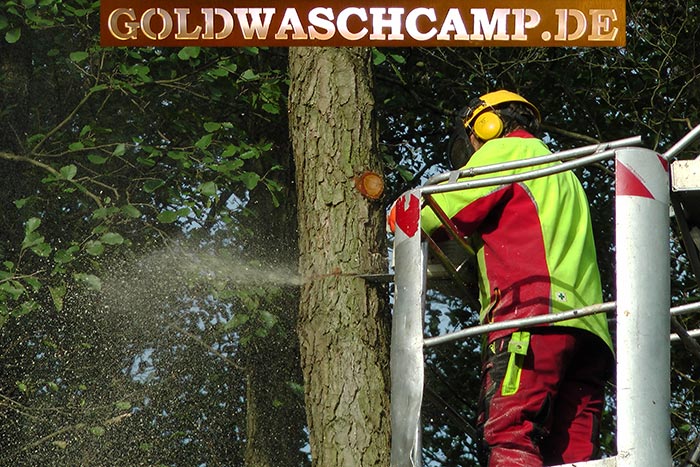
- Trees cut down and wood split for smoker, grill and campfire
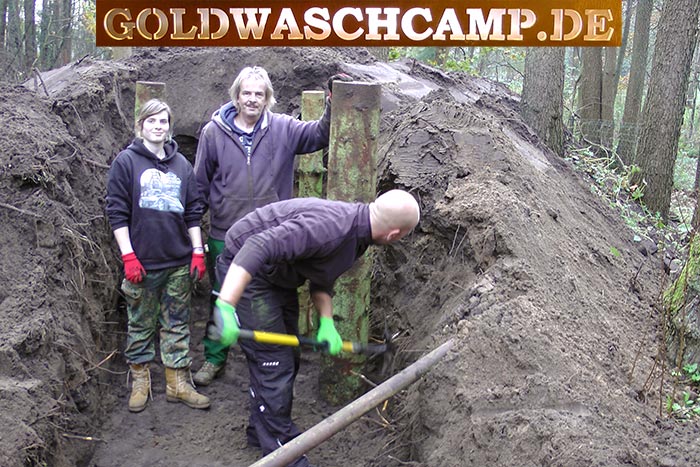
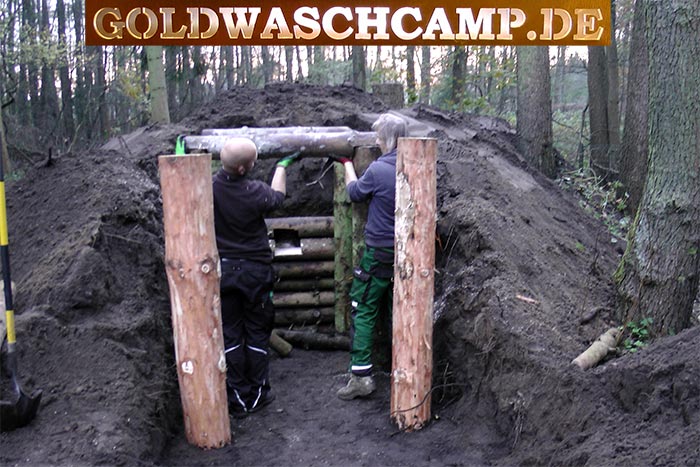
- The new gold mine is standing
- The large gold panning channel was excavated
- The mountain for the waterfall (and the dog Yukon) was piled up...
- The gold panning shop on Teufelsinsel has already opened!
- The mine cart welded and pushed into the mine
- Fire pit with large swivel grill and rustic seating created
- The gold panner's toilet (Brüllschacht!) installed and connected.
- The water channel lined with steel profiles, painted, and river sediment introduced.
- The waterfall designed and sealed with river stones from the Harz mountains.
- The practice troughs for children set up.
- Tables and benches for up to 70 people procured.
Space is being made for the new camp

The gold panning channel is being dredged


Of course, a gold mine is also a must


The barbecue area is being built

 Construction of the gold panner's toilet


The gold panning channel is installed


Start of the first course on May 28, 2018, everything works great!



The last time gold panning with my family without me knowing it October 25, 2020


April 13, 2021 My last day as a gold panner/husband and father!
Hello, I'm Jan Bollmann, the inventor of the gold panning camp in Wietze, but at the end of 2020/beginning of 2021, a severe stroke of fate hit me, I contracted leukemia. Despite fighting and hoping, I only lasted 3 months. So I passed away far too early on April 13, 2021, at only 57 years old. My wife Nicole had to continue the sale and my daughter Victoria had to continue my tasks, the construction of the gold panning products.
At the end of 2021/2022, she and her boyfriend Nico rebuilt and expanded the gold panning camp for you, which you can see here. They built a great new camp and developed an excellent concept.
So my daughter Victoria, at 22 years old, has been proudly continuing the gold panning camp in my name and memory since 2022!
Best regards from the gold panner Jan Bollmann
In memory of my father Jan Bollmann